
- Download Issue 65 (US Letter, 7,8 mb) Buy as Book on Demand here (US) and here (DE)

by Călin Dan
T. A. Z.
Being invited by my friend Zoran Erić to be part of this travelling project authored by our distinguished colleague Mischa Kuball has been a source of intellectual happiness. if walls could tell was a perfect environment for someone who, like me, is confronted day in day out with challenging situations, while trying to keep alive an institutional paradigm that does not really fit the times we live in. Museums are mostly seen as symptoms of the evolutions in society. I prefer a more ambitious approach, and propose museums as evolving paradigms who are not just reflecting, but actually (re)shaping reality to an extent that makes them more relevant than even museum people would like.
Precisely due to their symbolic and pragmatic significance, the museums have been submitted to a plastic surgery procedure meant to give them charms that were never there and to hide wrinkles that were actually the sign of a noble and active life. The botox of political correctness has inflated the museums’s profiles, transforming them into an unrecognisable (to me at least) creature, a sort of Mother-of-all-real-and-imagined-needs that a society of leisure can imagine.
Nursery, elementary-to-high-school-to-college classroom, night club, day lounge, theatre podium, neighbourhood kulturhaus, creative hub, social hub, meeting point, mating point, gourmet restaurant, cinema, yoga club, fitness club, luxury shop, bookshop, wine shop, anything … No matter how imaginative a museum director and his team could be, there is always something amiss, some magic service that the museum could cater to its public – and it does not. People are nowadays so easily pissed off ….
With such a mind frame I agreed to participate in Mischa’s project. And this worked for me as an instrument for getting some clarity about my own job, and also for stepping beyond some accumulated frustrations. Hopefully it worked like that for the MNAC’s visitors as well. Because the soft walls invented by Mischa and hosted by our museum could be compared to the Speakers’s Corner in Hyde Park, allowing anyone and everyone to have a (public) voice. But they are also more than that – an ineffable substitute for the walls of the institution, untouchable for the layman. Well inspired or just dull, funny, quirky or presumptuous, the texts and drawings scribbled on the MNAC’s walls simulacra offered to us by Mischa Kuball are granting an unexpected moment of freedom to the museum visitor. If that freedom is critical to the museum, so be it. If it has another aim – even one difficult to swallow – it’s okay.
Because this temporary freedom space installed on one of MNAC’s terraces makes visible another concept, which is for me the quintessential description of what a Museum should be nowadays. First of all – as a museum of art, the MNAC values above all the concept of artistic autonomy. Not to be mistaken with the concept of aesthetic autonomy, the autonomous dimension of art production guarantees that in any culturally oriented activities any socially determined ingredients, from political, to economic, to religious, to humanitarian, to ecological, to racial, a.s.o. have to be implicit, and by no means explicit. Only art created under this axiomatic principle can provide to the viewer the plus value that makes a difference between straightforward cultural experience and manipulative propaganda.
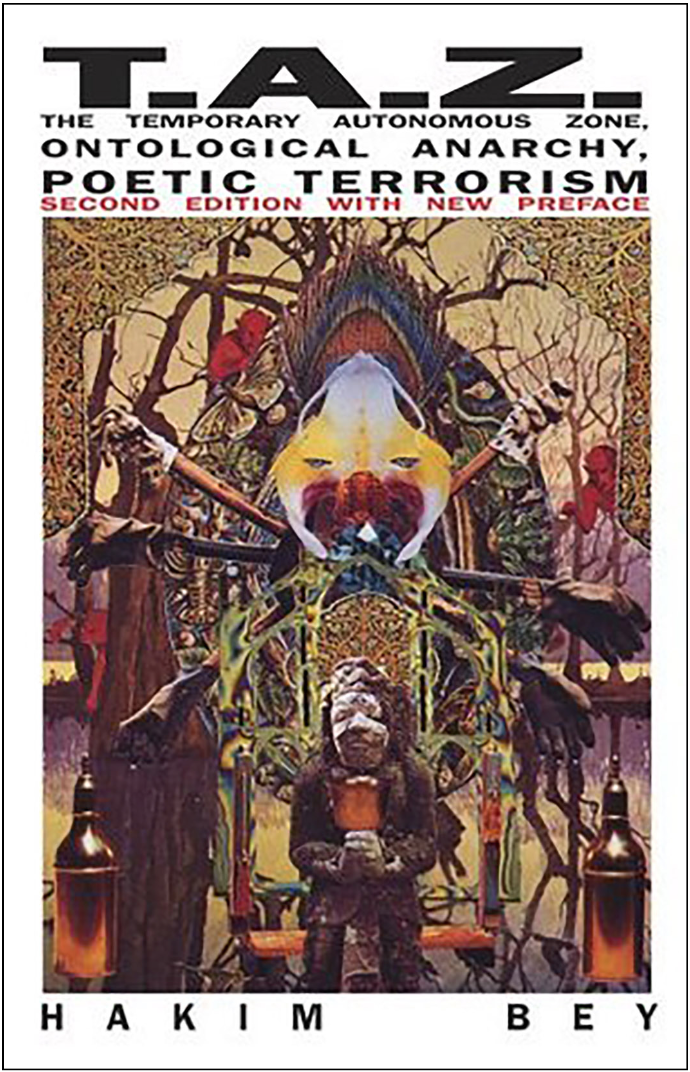
Cover of the book T.A.Z.: Temporary Autonomous Zone by Hakim Bey.
Museums in general are historically well equipped to encourage autonomy, not only of art, but of any other content that can be thought of. Expanding, I would say that today museums have the obligation to become Temporary Autonomous Zones, for many reasons. If we look at the history of this concept, as shaped by late Peter Lamborn Wilson, a.k.a. Hakim Bey in 1991, we realise that temporality and autonomy are precious qualities that are not much encouraged by societies, even now. Everybody is obsessed with a hedonistic aspiration to eternity, with permanence, and everybody is ready to trade freedom for safe conformity to norms. Being beyond norms, being independent, even for a day – is scary. But it is also an important part of the human condition. Without autonomy in its different forms, humanity would have not survived. At least not in the spectacular ways it did, until now at least. Thus, it is up to us, museum people, to offer space and means for revisiting autonomy, for enjoying it, and reflecting on its qualities.
It is a valuable paradox we should take from here – museums, as homes to the permanent values we rely upon are potentially zones of autonomy that could breed another type of social interaction through culture.
Călin Dan is visual artist with a background in art history and theory, Călin Dan reached international recognition with his work in the group subREAL, and independently with the long-term projects Emotional Architecture (2002-present), Anturaju’ and Other Stories (2006-2010), and Collective Authorship (2012-present). After 1989 he was advisor to the Mondriaan Fund and Pro Helvetia Romania, and leader to cultural institutions like “Arta” magazine, and the Soros Centre for Contemporary Art, Bucharest. Currently he is the director of the National Museum of Contemporary Art – MNAC Bucharest, where he elaborates strategies of recuperation, giving a platform to local conceptual artists from the 1970s and 1980s, while starting a regional network meant to define a significant cultural pole for artists and curators active in the former communist countries. His work was showcased at the Biennales of Venice, Istanbul, Sao Paolo, Sydney, and at the festivals: Ars Electronica, Linz; DEAF (Dutch Electronic Arts Festival), and Film Festival, Rotterdam; Media, film and video festival Osnabruck; Internationale Kurzfilmtages, Oberhausen; OSTranenie. Video Forum an der Stiftung Bauhaus Dessau, Videonnale Bonn, etc. Recipient of the Special Media Award of the Experimental Film Festival, Split (2000) and of the Videonnale Bonn award (2001).