
- Download Issue 65 (US Letter, 7,8 mb) Buy as Book on Demand here (US) and here (DE)

by Branka Benčić
Old Factory New Capital: The Museum of Modern and Contemporary Art in Rijeka (MMSU)
An attempt to reflect on the experiences of the project if walls could tell brings forward the opportunity to open a conversation about a constellation of practices at the MMSU - Museum of Modern and Contemporary Art in Rijeka, and explore some of its historical relations and reconnections. To frame this exploration, I have borrowed the title from an artwork by Igor Grubić, a text-based work and recent intervention in the form of a banner on the museum facade, reading Old Factory, New Capital (MMSU, 2024). Practices that frame the notion of plural publics recognize that communities are not monolithic but consist of overlapping identities. A community is not understood as a homogeneous body but as a meeting place — an intersection of different positions, voices, identities, and subjects. This reframes the notion of identity not as a fixed concept but as a polyphony of codes, both personal and collective, situated at the crossroads of multiple social and cultural layers. Thus, participatory art can serve as a platform for multiple publics to engage, negotiate, and build collective agency, positioning itself not merely as a method but as an ethical and political gesture. Rethinking the notion of ‘being-with’ (as individuals are always already part of shared experiences), instils plurality as inherently inscribed within the very idea of the public.

Igor Grubić: Old Factory New Capital, work on the facade, exhibition: Gestures of Activation, 2024. MMSU Museum of Modern and Contemporary Art Rijeka; Courtesy of MMSU. Photography: Hrvoje Franjić

David Maljković: With the Collection, installation view, MMSU Museum of Modern and Contemporary Art Rijeka, 2020. Courtesy of MMSU
Growing a community is a long-term, durational, and precarious process, often marked by instability. The Museum of Modern and Contemporary Art in Rijeka engages in diverse forms of community building along its historical trajectory of institution-building, since its establishment in 1948 as a new institution for a new society — first within the socialist country that emerged after the Second World War, and its relocations in search of a space, to the current venue, repurposed industrial building, tracing histories that reconnect the Museum with institutional and artistic practices dedicated to reclaiming public space. This legacy is inscribed in institutional and programmatic policies and perspectives that continue to reshape the worldview and the relationship between art and society. The new neighbourhood represents an effort to initiate a potential new beginning. Within this horizon, different museum departments — collection, education, exhibition, documentation — work together to activate, engage, and inspire audiences through a multifaceted program for a transgenerational community. From this perspective, participatory art at the Museum of Modern and Contemporary Art in Rijeka is considered less a fixed object than a moving target, a permeable space of encounter between artists, audiences, and the city. The museum is thus understood not as a container of singular voices but as a site where publics emerge in plurality and difference.
The dynamic interplay between participatory art and community engagement is both exhibited and enacted, infusing the institution with the vitality of ideas, voices, and gestures. Looking back at the museum’s exhibition histories — whether it was shows that trace the historical trajectory of interaction between the museum, the city, and the audience, or those that engage artistic and social imagination — one finds exhibitions that bring into public discourse themes and issues relevant to society, or that propose a provisional set of possible instructions for use.
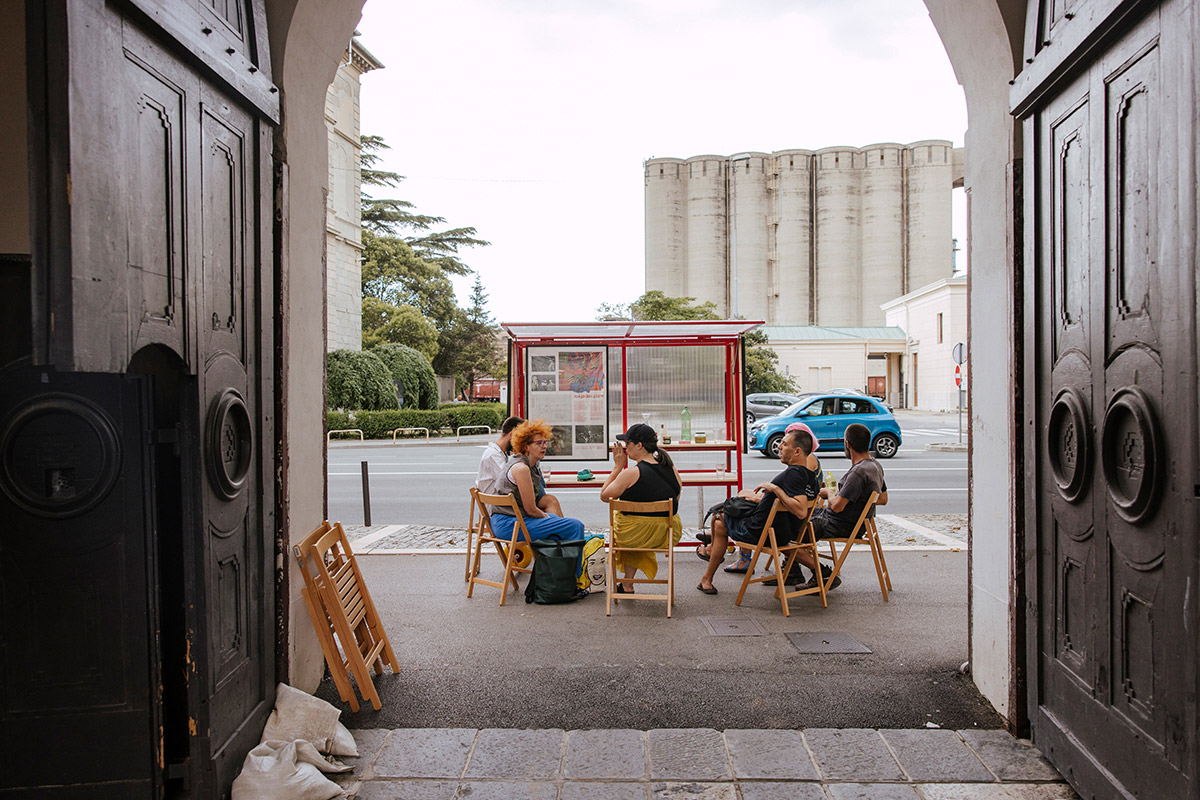
Curatorial Clique, workshop documentation, MMSU Museum of Modern and Contemporary Art Rijeka, 2024. Courtesy of MMSU. Photo: Tanja Kanazir
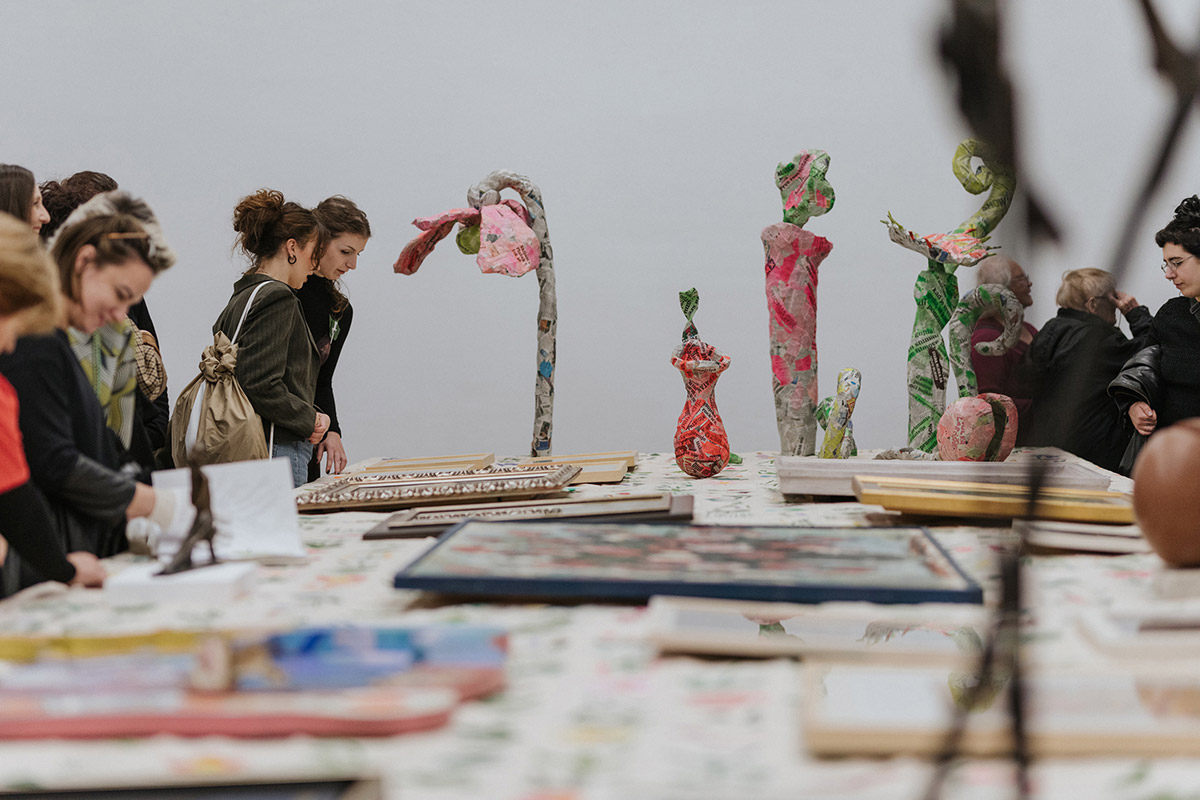
Kiosk, community project, documentation, MMSU Museum of Modern and Contemporary Art Rijeka, 2024. Courtesy of MMSU.
Parallel to exhibitionary activity, recent educational projects — ranging from guided walks that highlight the neighbourhood, contexts, or industrial heritage of the museum building’s former function, to intergenerational workshops and inclusive community co-curation — reimagine the museum as “common ground.” Initiatives such as the Curatorial Circle, which experiments with co-creation by involving citizens in drafting exhibition mediation texts, selecting artworks, interpreting the collection, and organizing displays, transform the museum into a forum of many voices. Here, each participant teaches and learns, proposing possible corrections to established narratives in the process of re-reading, re-arranging, strengthening, and rebuilding a sense of belonging. In this context, exhibitions alongside MMSU’s community-engaged workshops form a critical continuum: one that resists the museum’s traditional authority and redefines it as a space of listening, contradiction, plurality, belonging, and a shared horizon.
Branka Benčić is a curator and art historian based in Croatia with research, writing and curatorial interests in contemporary art, exhibiting film and video, curatorial practices and exhibition histories in former Yugoslavia. She is the director of the Museum of Modern and Contemporary Art in Rijeka (MMSU), where she has curated and co-curated exhibitions, research projects and public programs such as Sanja Iveković video retrospective Make up Make down (2021/2022); Hana Miletić Materials (MMSU, 2022); Igor Grubić Gestures of Activation - a Retrospective of Works in Public Space (2024), Continuities and Interruptions - (Salon 54). She was commissioner and curator of the Croatian Pavillion at 57th Venice Biennale (2017). Recently, she guest curated the annual Keller Kino at Kunsthaus Graz and curated the theme program Solidarity as Disruption at the International Short Film Festival Oberhausen among others. She was artistic director and co-founder of an independent art organization Apoteka – Space for Contemporary Art. As an independent curator she has curated group and solo exhibitions and film screenings in Croatia and internationally, lectured on contemporary art and exhibited film and video and published in exhibition catalogues, books and journals.